
ex00: ft_iterative_factorial
Factorial means for example 5! = 1 * 2 * 3 * 4 * 5.
We define these int:
iis the upcoming numbernis the current
We start both i and n as 1
If nb is zero, then return 1.
While i which is our next number doesn't equal the number, we increment i we multiply n by i and store it inside n
So that would be 1 * 2 for the first iteration, n now equals 1 * 2 = 2.
Next iteration, i becomes 3, so when we multiply n by i, where n = 1 * 2 and now it's 1 * 2 * 3, 3 coming from i. And the next iteration, i is four and so on.
This is what is called an iterative approach.
ex01: ft_recursive_factorial
Factorial means for example 5! = 1 * 2 * 3 * 4 * 5.
We first check if nb is less than 0, if yes we return 0, and we return 1 if nb is 0.
If not, we return our current nb * ft_recursive_factorial of nb - 1
This causes it to multiply starting from the largest number which is the first nb, then nb - 1, and so every time the function calls itself it multiplies nb one less, until we end up with the number.
This is what is called a recursive approach, where the function calls itself to do a small portion of it's own behavior.
ex02: ft_iterative_power
Power in this case means multiplying a number with itself power times.
We define these int:
icounts how many times we did the multiplicationbasenumis thenbwe start with, since it must stay constant
We start with i as 0 and basenum with nb
If power is zero, then return 1.
While i is less than the power - 1 (because we start counting from 0, 0 is the first), we increment i we multiply nb by basenum and store it inside nb, and we increment i
So that would be nb * basenum for the first iteration, nb now equals nb squared.
Next iteration, nb becomes nb * basenum which also equals basenum * basenum * basenum, which is why it's nb to the power of 3. And the next iteration, i is four and so on.
This is what is called an iterative approach.
ex03: ft_recursive_power
Funnily enough, recursive power works the exact same way as recursive factorial, except power - 1 is passed as power, and nb is left in tact.
ex04: ft_fibonacci
Formula for the Fibbonachi sequence is:
$F_n = F_{n-1} + F_{n-2}$
We hardcode that index 0 and 1 stay the same in Fibonacci sequence, because 0 is always 0 and 1 is always 1 in Fibonacci sequence.
The formula already tells us this has to be recursive, so does the exercise, and it's pretty much an insert.
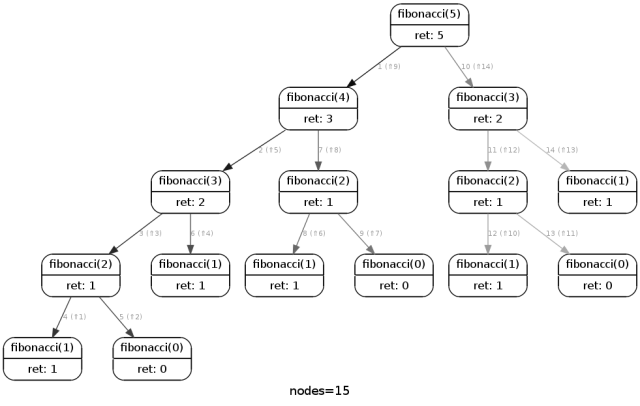
The way this works is imagine that the first call eg. ft_fibonacci(5) is a box with 2 boxes inside. Those boxes are ft_fibonacci(4) and ft_fibonacci(3) respectively.
Inside those boxes are also smaller boxes ft_fibonacci(2) and ft_fibonacci(1). Only the value of ft_fibonacci(1) and ft_fibonacci(0) are known to be 1 and 0 respectively.
So in the end we end up with a row of 1 and 0 resulting from the tree of opening those boxes, and adding these together results in the value of our initial/largest box.
We return -1 if the starting number is negative which is not allowed.
Here's a visualization I found on Google:
Because we need to check if the input is invalid and return 0 in that case, we just check if the number is less than 0 which isn't allowed. That's it.
ex05: ft_sqrt
Instead of trying to calculate the square root, we can just try to go through all, starting from 0 all the way to 46340. Why that number? Because it's the last squared number that would result in a number that is small enough to fit below INT_MAX, go higher and it will overflow.
ex06: ft_is_prime
If the number is 0 or 1, then it can't possibly be a prime number, so return 0 there.
Now attempt to divide the number by everything below it except for 1, if you hit one that has no remainders, then it can't be a prime number, since it's not just divisible by itself.
If it's only divisible by 1 or itself, it's a prime number.
ex07: ft_get_next_prime
Use ft_is_prime to see if the current number is a prime. If it isn't, increment and try again, until you finally hit a prime number.
ex08: Ten Queen Puzzle
TODO
 Browse source files
